Live Local: One Size Does NOT Fit All
MultifamilyCristian O. Oquendo, AIAMarch 202610 min read
There is a growing willingness among developers and multifamily investors to unlock more potential through Florida's Live Local Act.
Across different markets, many are asking a practical question: what can this actually unlock on a specific site when the local rules are fully understood?
Live Local is a powerful state framework. It can open up locations that didn't make sense under traditional zoning and create real opportunity for both housing and returns. The challenge is that the law sits on top of a patchwork of local multifamily rules that are easy to underestimate or simply not see at first glance.
Understanding how state-level tools interact with local code is where smart teams can turn Live Local from a headline into a repeatable strategy.
Where Good Assumptions Get Stretched
Most of the time, the issue is not overly aggressive underwriting. It is reasonable assumptions meeting very different local realities.
A typical path looks like this:
- A team sees a strong Live Local deal in one Florida market and learns the basics of how that project worked.
- They apply similar yields or building envelopes to a new site in another jurisdiction.
- Then, as they dig into local requirements, they discover standards that tighten setbacks, green space, parking, or site design more than expected.
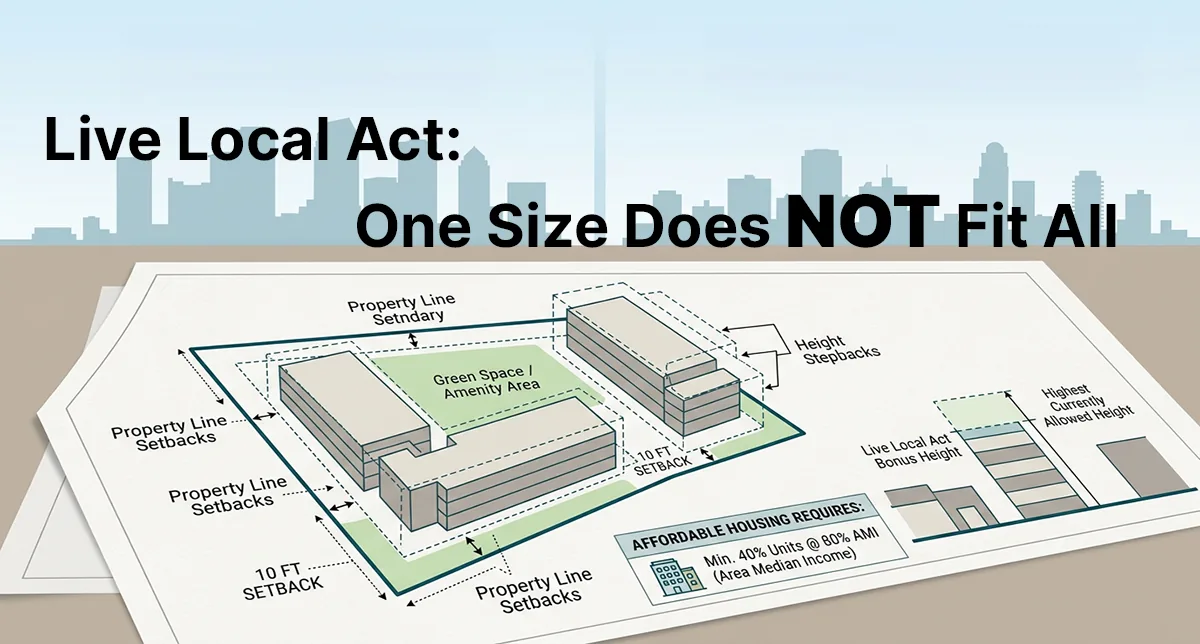
Live Local can give you meaningful tools on use, height, and density when you meet the affordability thresholds. At the same time, local multifamily standards still shape what you can actually build:
- Setbacks and stepbacks that define your true building envelope
- Open space and green space definitions that affect site layout
- Parking ratios and access requirements
- Stormwater, utilities, and infrastructure capacity
- Local design, buffering, and compatibility rules
From the outside, it is not obvious how much these layers vary city to city and county to county. That is why two sites that both "qualify for Live Local" on paper can deliver very different outcomes once local rules are applied.
Tampa: The Details Are in the Memo
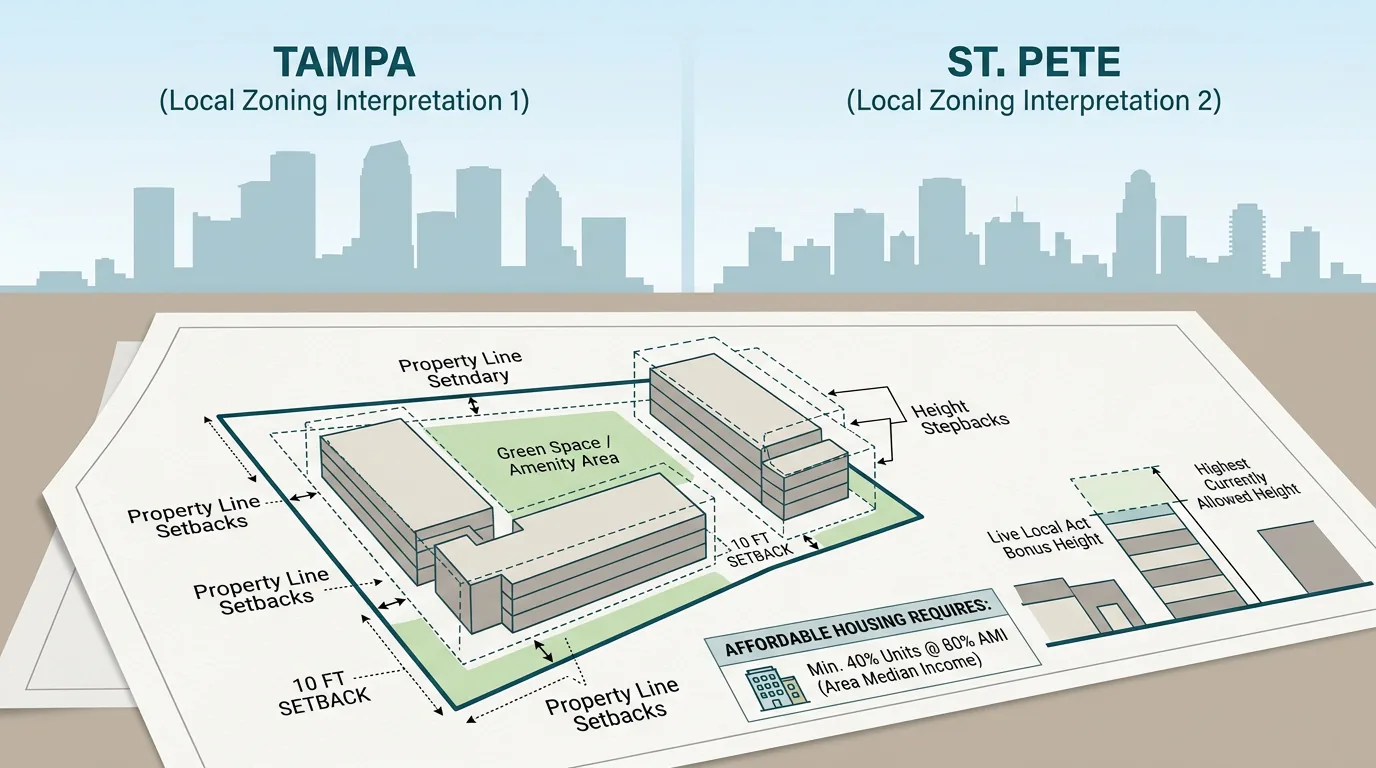
Tampa is a good example of how local implementation really matters. For anyone working in that market, the City's own Live Local page is the best starting point: City of Tampa – Live Local Act.
The city has issued specific guidance on how it will handle Live Local projects. That memo becomes required reading if you're trying to entitle a site there.
Two pieces that often move the needle:
- Setbacks and stepbacks: You do not get to ignore your edges just because you qualify for Live Local. The memo clarifies how front, rear, and side setbacks apply, and once you go above 30 feet in height, for each 4 feet of additional building height the required yards increase by 1 foot. That combination can materially change your building envelope, massing, and ultimately unit count as you add floors.
- Green space: Tampa differentiates between general outdoor space and true, permeable green space. The expectation is not just hardscape plazas and amenity decks; it is actual natural, pervious areas. In some cases, there is also a funding or fee structure tied to how you meet those requirements.
On paper, two Tampa sites might both be "Live Local candidates." Once you design to the memo and the local standards, the real capacity of each site can look very different.
St. Pete: A Local Version With Its Own Rules
St. Petersburg has taken a more customized approach by writing its own code to implement Live Local concepts, and it has paired that with a clear focus on affordable housing implementation and tracking: Affordable Housing St. Pete – Actions Taken Dashboard.
A useful companion reference is St. Petersburg's official Municode code library, where the workforce housing bonus density framework is codified: St. Petersburg Code of Ordinances. That framework is commonly described as requiring, for each multiple of six workforce housing bonus density units approved, the first unit to be offered at 80% AMI or below, with the remaining bonus units offered at or below 120% AMI.
In some scenarios, their local program can be more attractive than relying solely on the baseline state provisions. There can be:
- Clearer, codified pathways for height and density
- Local incentives that align better with the city's goals
- A more predictable review process once you understand the rules
But there is an important caveat: the affordability requirement. To access certain benefits, you may need to commit to units at around 80% AMI. For some projects, that level of affordability still pencils and the local program is a net positive. For others, it changes the economics to the point where the deal no longer makes sense.
Again, same state framework at the top, very different outcomes once the local code and local policy layer on.
Beyond the affordability targets, St. Pete has also baked meaningful entitlement clarity into its code. Under Section 17.5-110 and related provisions, qualifying affordable and workforce housing projects can pursue a more predictable site plan approval path, with density and height keyed directly to the Live Local framework and clearly mapped back to local districts. For example, Section 17.5-111(f) sets a maximum of 82 dwelling units per acre and ties height to the highest commercial or residential height within one mile or three stories, whichever is greater, with NSM-1 standards for Industrial sites and the underlying commercial/mixed-use standards elsewhere. See: §17.5-110 and §17.5-111(f).
A Moving Framework, Not a Fixed Target
Another reality: Live Local is still evolving.
The Legislature has already gone back to refine and adjust the act, and new bills continue to clarify definitions, timelines, and affordability standards. That means the rules a team saw in an older presentation may not fully match the rules in place today or those that will apply to a project starting a year from now.
For serious teams, that is a signal to treat Live Local as an active framework that needs to be monitored, not a one-time headline you underwrite around forever.
What Successful Teams Are Doing Differently
The groups that are actually getting Live Local projects approved and built tend to approach it in a more disciplined way:
- They underwrite Live Local site by site, instead of assuming the same yield everywhere.
- They start with the state framework but quickly move into the specifics of that city or county's multifamily standards.
- They bring in local expertise early: planners, land-use counsel, and design teams who live in that jurisdiction's code and have already taken Live Local projects through the process.
Projects in both Tampa and St. Pete show that Live Local can absolutely make the difference between "interesting idea" and "approvable plan." In other cases, trying to force a Live Local concept onto the wrong site or into the wrong jurisdiction creates more friction than value.
Takeaway for Developers and Investors
Live Local is a tool, not a guarantee.
If you're looking at a Florida site and thinking about a Live Local strategy, it is worth asking a few simple questions up front:
- How does this jurisdiction actually implement Live Local in practice?
- What are the multifamily standards that still apply to this parcel?
- How will affordability requirements at this location affect rent assumptions and returns?
- Who on the team truly understands the local version of this law?
Bottom line: When those questions are answered early and honestly, Live Local can be a powerful way to unlock value. When they are ignored, it becomes very easy to build a pro forma around a yield that was never realistic for that specific jurisdiction in the first place.
If you're working on a project where the Live Local Act might apply, reach out. We've navigated its requirements on multiple projects across Florida and are happy to talk through the implications early.