Roof Framing Considerations on Type IIIA Projects
Code + ComplianceMartin Lehr, AIAApril 20256 min read

FBC & IBC Table 601 & Chapter 2 Definitions
Type IIIA construction requires 2HR exterior wall assemblies for bearing walls. This article examines why common roof truss configurations may not achieve non-bearing wall criteria, and two practical paths forward.
The Issue
Type IIIA construction is required to provide 2HR exterior wall assemblies for bearing walls. This requires an additional layer of 5/8" Type X gypsum sheathing on the interior face of the wall.
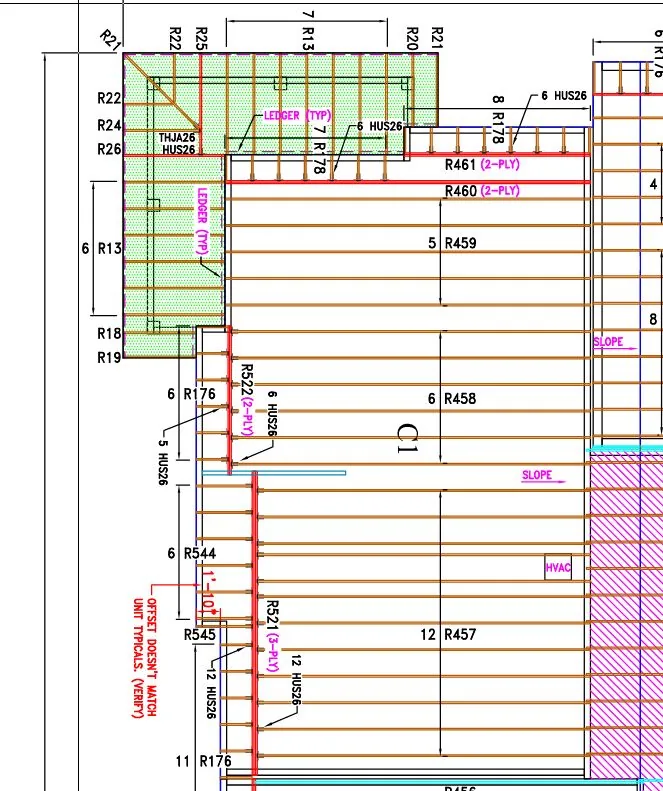
We have historically proposed framing modifications to our roof trusses to ensure that a girder truss is positioned close to the exterior wall so that the load is minimized, the goal being to achieve non-bearing wall criteria. In this configuration, girder trusses carry the primary load while jack trusses frame between them, reducing the gravity load transferred to the exterior wall.
Why It Doesn't Work
While the girder truss configuration does reduce the simple gravity load on the exterior wall to meet the non-bearing definition (less than 100 lbs per lineal foot in addition to its own weight), it does not sufficiently decrease the total design gravity load, which incorporates additional factors such as wind.
The total design gravity load on the exterior wall well exceeds the limits of the non-bearing wall definition, even with girder trusses positioned close to the wall.
As an example: a jack truss at 24" on center can show a gravity load at the exterior wall bearing point of approximately 1,277 lbs. Dividing by two (for the 24" spacing), the per-lineal-foot load still well exceeds the non-bearing wall threshold.
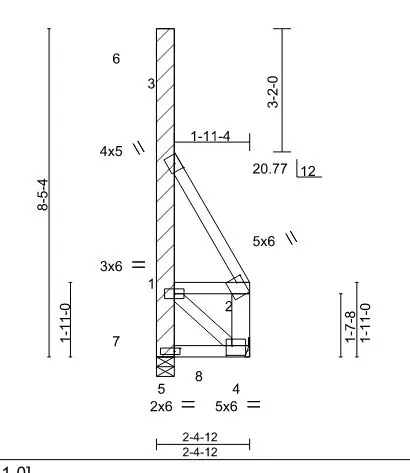
All this to say: this configuration would still require the exterior walls to be 2HR rated.
Proposed Resolution
There are at least two viable options:
Option 1: Balloon or Semi-Balloon Framing
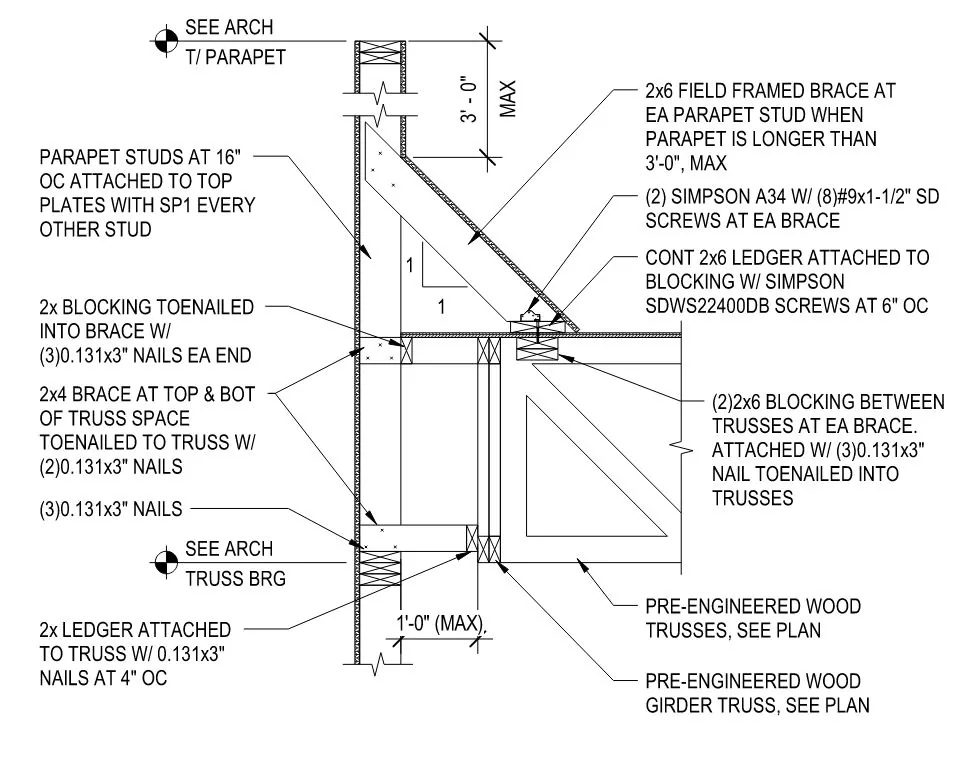
Frame the exterior wall using balloon or semi-balloon framing for the top-level portion, ensuring that no additional loads from the roof structure are placed on the exterior wall. This approach decouples the roof from the exterior wall entirely, allowing the wall to remain classified as non-bearing.
This requires careful coordination with the structural engineer and truss manufacturer to ensure the interior bearing lines are properly designed to carry the full roof load.
Option 2: Provide 2HR Wall Ratings
Accept the bearing wall classification and provide 2HR wall ratings for the exterior walls with a simple framing layout that has the roof trusses bear directly on the exterior wall. This is the more straightforward approach and simplifies the framing package, though it adds the cost and labor of the additional gypsum layer.
Key takeaway: When evaluating whether exterior walls qualify as non-bearing in Type IIIA construction, teams must consider the total design gravity load, not just the simple gravity load. Wind and other lateral forces can push the loading well beyond non-bearing thresholds, even with optimized truss configurations.
Coordination Notes
- Confirm bearing wall vs. non-bearing wall classification with the structural engineer early in design.
- Request full truss loading data (including wind) from the truss manufacturer before finalizing the wall rating strategy.
- If pursuing Option 1, ensure the balloon/semi-balloon framing detail is clearly documented in the construction drawings.
- If pursuing Option 2, coordinate the 2HR wall assembly detail with the fire protection consultant and verify compliance with FBC/IBC Table 601.
Technical Information & Proposed Solutions (T.I.P.S.) documents are an open forum for sharing information among staff members. They represent threads of knowledge from lessons learned during the history of this firm too important to be forgotten. They are meant to be tools to help each team member elevate the standard of care and practice of architecture by helping head-off and avoid these conflicts and issues on future projects.
T.I.P.S. documents reflect "Resolutions Achieved" and "Commentaries" based on applicable codes, products available, and interpretations of the specific jurisdictions where these issues initially surfaced. They may not in part or as a whole apply to any future projects. They are intended for general reference only and do not relieve team members on future projects from the responsibility of thoroughly familiarizing themselves with applicable codes for each project.